Today's Power SMD Resistors: Smaller, Lighter, Faster
Recent advancements in power surface mount device (SMD) resistors have brought about notable enhancements in performance capabilities. The latest products now offer three times the power compared to resistors manufactured just a few years ago, accompanied by a parallel increase in the power-to-size ratio. These technological strides have led to the creation of devices that are not only smaller and lighter but also exhibit improved robustness in performance.
As with all things in the electronics industry, advancements in design and production are enabling manufacturers to continuously improve their portfolio.
What Is A Surface Mount Chip Resistor?
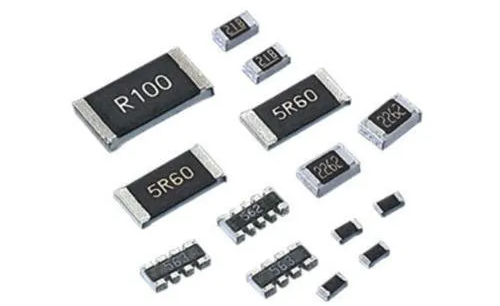
A surface mount resistor is a small ceramic component with silver conductive edges at both ends, often in a rectangular shape. Also known as surface mount technology, this type of resistor provides benefits by conserving space on printed circuit boards (PCBs). The resistance value code is typically printed on the resistor where space allows. During the assembly process, solder paste is applied to the mounting pads on the PCB. Automated pick and place equipment then accurately positions the resistors onto these pads. The entire board is subsequently conveyed through a reflow oven, where the solder is melted, establishing secure contacts.
A chip resistor is a passive electronic component designed to regulate the flow of both Direct Current (DC) and Alternating Current (AC). One of its fundamental functions is to either decrease voltage or maintain a constant current within an electronic circuit. The behavior of resistance adheres to Ohm's Law, with the resistance value determined by the combination of materials featuring varying levels of electrical conductivity. Common materials utilized in chip resistors include Ag (silver), Pd (palladium), RuO₂ (ruthenium dioxide), CuNi (copper-nickel), among others. These materials are employed in the production of general resistors, array resistors, ultra-low resistors, sulfur-resistant products, high-power products, and environmentally friendly variants.
How Are SMDs Made?
Surface Mount Devices (SMDs) are manufactured through a process involving the placement of end connection electrode bases onto an alumina or ceramic substrate. Subsequently, the resistor undergoes a firing process to secure the electrodes in place. Following this, a resistive material film is either printed or deposited onto the substrate, and the resistor undergoes another firing cycle. To safeguard the resistor, successive layers of a protective coating are applied, each drying between applications. These layers serve to prevent mechanical damage and the penetration of moisture and other contaminants. If the surface allows, a marking is added to the resistor. The completed resistors are then packaged in blister rolls for use with pick and place machines, or they can be supplied as standalone components.
How To Identify Smd Resistors Codes?
1. Digital cable nominal method (generally used for rectangular chip resistors)
The digital cable nominal method involves marking the resistance of a resistor with digits. The first and second digits are considered significant, while the third digit indicates the number of "0"s added after the significant digits. No letters are used in this method. For instance, "472" signifies "4700Ω," and "151" represents "150Ω."
SMD resistors typically have their resistance values directly marked on the surface in digital form. The resistance value can be read directly from the numbers on the resistor surface. Three common representation methods are as follows:
(1) Three-digit code: Indicates a tolerance of ±5%. The first two digits are significant, and the third digit represents the multiplier of 10 (the basic unit is Ω). For example, "103" represents 10 × 10 = 1000Ω = 1KΩ.
(2) Four-digit code: Indicates a tolerance of ±1%. The first three digits are significant, and the fourth digit represents the multiplier of 10. For instance, "1502" translates to 150 × 10 = 1500Ω = 1.5KΩ.
(3) Numeric and letter code: Examples include "5R6" and "R16." Here, "R" is replaced with a decimal point.
"5R6" means 5.6Ω.
"R16" signifies 0.16Ω.
It's crucial to note that "R" represents resistance, and "Ω" is the unit of resistance. While in daily life, the two might not be mixed, in industrial production, the boundary between them can be vague.
2. Nominal color ring method (generally used for cylindrical fixed resistors)
Surface Mount Device (SMD) resistors share similarities with conventional resistors, employing four rings (occasionally three rings) to denote their resistance. The first and second rings represent significant digits, while the third ring indicates the multiplier (color ring codes are detailed in Table 1). For instance, "Brown Green Black" signifies "15Ω," and "Blue Gray Orange Silver" denotes "68kΩ" with a tolerance of ±10%.
3. E96 digital code and letter mixed nominal method
The mixed nominal method incorporates both digital codes and letters, utilizing three digits to convey the resistance value, denoted as "two digits plus one letter." In this method, the two digits represent the E96 series resistance code, and the third digit signifies the multiplier expressed by a letter code (as detailed in the table). For instance, "51D" translates to "332 × 10^3" or "332kΩ," while "249Y" signifies "249 × 10^-2" or "2.49Ω."
SMD Resistors Size
Surface-mount resistors adhere to standardized shapes and sizes, with many manufacturers adopting the JEDEC standard. The dimensions of an SMD resistor are typically represented by a digital code, such as "0603." This code signifies the package's width and height. For instance, in the case of the 0603 Imperial code, it means the length is 0.060 inches, and the width is 0.030 inches. While this code can be expressed in either English or metric units, English codes are more commonly used to indicate package size. However, in contemporary PCB design, metric units (mm) are prevalent, potentially causing confusion. As a general rule, one can assume that the code is in English units, but the size unit used is in millimeters. The dimensions of an SMD resistor are primarily determined by the required power rating.
GUOYUAN ELECTRONICSoffers a variety of chip resistors series so you can find the smd chip resistors you need. All surface mount chip resistors boast low contact resistance, an environmentally conscious feature that saves energy by reducing the amount of energy converted to heat during operation.
We use cookies on our website to see how you interact with it. By accepting, you agree to our use of such cookies. privacy policy
Advanced Cookie Settings
Essential Cookies
These cookies enable core functionality such as security, verification of identity and network management. These cookies can’t be disabled.
Enable Marketing Cookies
These cookies are used to track advertising performance, consent to the sending of advertising-related user data to Google, and consent for the website to serve personalized advertising to provide more relevant services.
Enable Functional Cookies
These cookies collect data to remember choices users make to improve and give a more personalised experience.
Enable Analytics Cookies
These cookies help us to understand how visitors interact with our website, discover errors and provide a better overall analytics.

 Discrete Semiconductor Products
 Motors, Actuators, Solenoids and Drivers
 RF/IF and RFID
 Integrated Circuits (ICs)
 Inductors, Coils, Chokes
 English