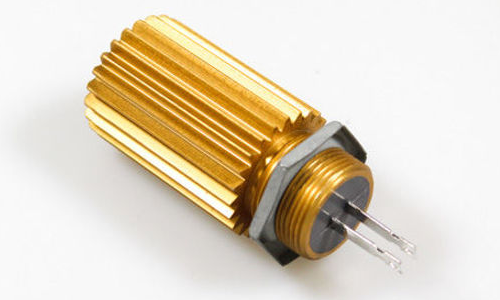
A chassis mount resistor is produced utilizing wirewound resistor technology and incorporates a ceramic core molded into an extruded aluminum chassis mount housing. The wirewound design is optimized for effective pulse handling, and the aluminum housing enhances heat conduction capabilities. These chassis mount resistors are meticulously engineered to cater to diverse applications such as motor control, braking systems, welding, and X-ray systems.
A chassis mount resistor is a wirewound resistor housed in an extruded aluminum chassis mount housing that promotes heat loss and cooling. Its design maximizes pulse handling and provides superior heat conduction. Chassis mount resistors can be attached to heat sinks to dissipate which allows for the use of higher power as the heat that is generated is dissipated very quickly.
What Is A Chassis Mount Resistor Made Of?
Chassis mount resistors are manufactured using wirewound resistor technology in a large ceramic core molded into an extruded aluminum chassis mount housing. The wirewound design maximizes pulse handling, and the aluminum housing provides superior heat conduction.
Alloys are the predominant choice for the production of wirewound resistors, as pure metals exhibit a high temperature coefficient of resistance (TCR). However, in instances requiring resistance to elevated temperatures, pure metals like tungsten are often employed. The temperature coefficient serves as a metric for gauging how much the resistance of a resistor will alter with changes in temperature, typically measured in units of ppm/˚C. For example, if a resistor is rated at 50 ppm/˚C, it implies that the resistance of the resistor will not deviate by more than 50 ohms for every 1 million ohms of the resistor's given value, corresponding to a temperature change of 1 ˚C.
Typical alloys that are used as resistor wire are:
Copper alloys
Silver alloys
Nickel chromium alloys
Iron chromium alloys
Iron chromium aluminum alloys
ConstructionOf wirewound Chassis Mount Resistor
The construction of wirewound resistors exhibits significant variability, determined by the intended use within an electrical circuit. Manufacturing methods and material choices are tailored to the specific requirements of the resistor. In general, wirewound resistors are created by wrapping a wire around a core. The resistance value is contingent upon factors such as the resistivity of the wire, its cross-sectional area, and its length. Precise control over these parameters allows for the achievement of high-precision resistance.
For applications demanding high tolerance, the resistance value is meticulously measured to determine the exact length for wire cutting. Achieving high resistance involves using a very thin wire with an extended length. Consequently, wirewound resistors are predominantly manufactured for lower resistance values. In instances of low power ratings, extremely fine wire is employed, and the delicate handling of such thin wire is critical due to its susceptibility to damage, which could lead to wire severance. Following the winding process, measures are taken to shield the wire from moisture, preventing electrolytic corrosion.
Additionally, wirewound resistors with high power ratings, such as 50W or more, exhibit a distinct construction. In contrast to other resistor types like metal film, these resistors feature a relatively large wire diameter, enhancing their robustness and durability.
Key Features Of Chassis Mount Resistors
Wirewound Technology: Chassis mount resistors often utilize wirewound resistor technology, where a resistive wire is wound around a ceramic core. This design enhances their ability to handle pulses of electrical energy.
Aluminum Housing: The wirewound resistor is typically housed in an extruded aluminum casing. This aluminum housing serves as a heat sink, facilitating the dissipation of heat generated during resistor operation. Effective heat dissipation is crucial for maintaining the stability and reliability of the resistor.
Mounting: Chassis mount resistors have mounting hardware that allows them to be securely attached to the chassis or heat sink of the equipment. This mounting arrangement ensures good thermal contact for efficient heat transfer.
Applications: Chassis mount resistors find applications in various electronic systems, particularly those that involve high-power applications or environments where effective heat dissipation is essential. Common applications include motor control, braking systems, welding equipment, and X-ray machines.
In summary, a chassis mount resistor is a specialized resistor designed for direct attachment to the chassis or heat sink of electronic equipment, providing both resistance in the circuit and efficient heat dissipation.
Key Advantages Of Chassis Mount Resistor
Chassis mount resistors offer several advantages, making them suitable for specific applications where effective heat dissipation and robust performance are essential.
Heat Dissipation: Chassis mount resistors are designed with an extruded aluminum housing, which serves as an effective heat sink. This feature allows them to dissipate heat efficiently during operation, making them suitable for high-power applications where heat generation is a concern.
Pulse Handling Capability: The wirewound technology often employed in chassis mount resistors enhances their ability to handle pulses of electrical energy. This makes them well-suited for applications that involve fluctuating or pulsed loads.
Durability and Robustness: The construction of chassis mount resistors, with their sturdy aluminum housing and wirewound design, contributes to their durability and robust performance. This makes them suitable for demanding environments and applications where reliability is crucial.
Mounting Options: Chassis mount resistors are specifically designed for easy attachment to the chassis or heat sink of electronic equipment. The mounting options provided make them convenient for integration into various systems, ensuring good thermal contact for effective heat transfer.
Versatility in Applications: Chassis mount resistors find applications in a range of electronic systems, including motor control, braking systems, welding equipment, and X-ray machines. Their versatility makes them suitable for scenarios where both resistance and effective heat dissipation are critical.
Physical Stability: Being securely mounted to the chassis or heat sink contributes to the physical stability of chassis mount resistors. This stability is beneficial in applications where vibration or mechanical stress may be a concern.
In a word, the advantages of chassis mount resistors lie in their ability to handle heat effectively, their durability, versatility in applications, and their design for secure mounting in electronic systems where robust performance is essential.
GUOYUAN ELECTRONICSoffers a variety of chassis mount resistor series so you can find the wirewound chassis mount resistor you need. All wirewound chassis mount resistors boast low contact resistance, an environmentally conscious feature that saves energy by reducing the amount of energy converted to heat during operation.

 Discrete Semiconductor Products
 Motors, Actuators, Solenoids and Drivers
 RF/IF and RFID
 Integrated Circuits (ICs)
 Inductors, Coils, Chokes
 English