Here arrives a lineup of high temperature SCR (silicon controlled rectifier) thyristors, marking the debut of circuit protection devices that provide a junction temperature of 150°C. These innovative devices come in a compact surface mount D-PAK (TO-252) packaging, setting a new standard in the industry.
These scr electronics thyristors devices are also accessible in through hole V-PAK (TO-251) configurations.
The Standard SJ Series SCR Thyristors exhibit a low gate current trigger level, with 6mA or a maximum of 15mA at approximately 1.5V.
Within the series, sensitive models feature a gate trigger current of less than 200μA, making them easily triggerable by sense coils, proximity switches, and microprocessors.
Applications for SJ Series SCR Thyristors encompass capacitive discharge ignition (CDI) systems for motorcycle engines, ignition systems for portable generators, strobe lights, nailers, as well as serving in generic rectifiers, battery voltage regulators, converters, and inrush current limiting circuits in AC-DC converters.
They prove ideal for incorporation into controls for power tools, home/brown goods (such as consumer electronics like televisions, radios, digital media players, and computers), and white goods/appliances.
SJ Series SCR Thyristors Offer Notable Advantages:
A high junction temperature of 150°C provides a broader operating margin in existing designs and permits the use of smaller heat sinks in new designs.
The compact D-PAK and V-PAK packages facilitate smaller board designs, allowing for the replacement of larger TO-220AB and TO-263 packages.
The robust clip attach package design ensures high surge capability, enabling tolerance to harsher operating conditions.
High di/dt capability facilitates increased voltage output in capacitor discharge ignition applications.
Implementing 2 Phase Control for the Regulation of 3 Phase SCR Controller Heater Using Thyristor (SCR) Power Controllers
A cost effective method for toggling three phase heating loads involves selectively switching two of the phases. This approach is applicable to delta or floating star (without a neutral) loads equipped with constant resistance heaters.
This switching method operates on the principle that when two phases are switched off, the third phase lacks a return conduction path. This particular two phase switching is limited to burst cycle or on/off firing of the thyristors, as phase angle firing cannot be employed with this approach.
There are two primary advantages to employing two-phase switching for three phase load control. Firstly, it reduces costs by eliminating one thyristor module from the circuit. Secondly, the thyristor power controller dissipates less heat since there are only two thyristor modules in the circuit instead of three. The diminished heat dissipation reduces the need for enclosure fan cooling and keeps the control panel cooler, thereby maximizing the lifespan of the power electronics.
CD Automation offers a diverse range of two-phase switching thyristor power controller assemblies, ranging from 30 amps per phase with the REVO-S and REVO-M series to 2700 amps per phase with the MULTIDRIVE 2 Phase controller.
All these controllers feature an RS485 communications port using the Modbus RTU protocol. This allows users not only to configure the thyristor remotely but also to monitor critical electrical parameters such as current, voltage, and power. Fieldbus modules are available to convert Modbus RTU RS485 to Profibus, Ethernet, Devicenet, and CANbus.
Semiconductor protection fuses are integrated into the thyristor and come as standard. CD Automation provides guidance on all aspects of selection, application, configuration, and commissioning.
What is A Thyristor?
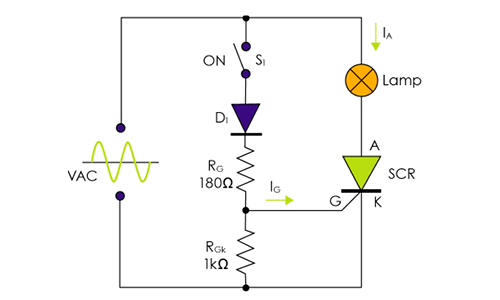
A thyristor is a semiconductor device with a four layer structure, comprising alternating P-type and N-type materials (PNPN). Typically equipped with three electrodes – an anode, a cathode, and a gate, also known as a control electrode.
The widely used type of thyristor is the silicon-controlled rectifier (SCR). When the cathode is negatively charged relative to the anode, no current flows until a pulse is applied to the gate. Subsequently, the SCR conducts current until the voltage between the cathode and anode is reversed or reduced below a specific threshold, known as the holding value. This type of thyristor allows the switching or control of substantial power with a minimal triggering current or voltage.
For devices operating on alternating current, a signal to the control gate can turn them on and off. Such a device is termed a gate turn-off, or GTO, thyristor. Unlike earlier thyristors that required the current to be reversed for turning off, GTO thyristors are adaptable to both alternating and direct current systems.
Thyristors are valuable in switching applications due to their binary on or off states. This characteristic sets them apart from transistors, which operate in intermediate states between on and off, awaiting a signal to conduct current.
3 States of Thyristors
Thyristors function in one of the three distinct states, based on specific operational needs:
Forward conducting: This constitutes the primary operating mode of a thyristor. It is switched to a conducting state and remains in that condition until the current decreases below a designated level known as the holding current.
Forward blocking: In this mode, the thyristor hinders the flow of current, even when voltage is applied in a direction that would typically prompt a diode to conduct.
Reverse blocking: When current attempts to traverse the thyristor in the opposite direction, a diode like blocking occurs, preventing activation of the thyristor.
Applications for Thyristors
Thyristors, renowned for their ability to handle high voltages and facilitate straightforward switching between on and off states, find applications in various domains, including:
Speed controls; Light dimmers; Camera flashes.
Various circuit types such as inverters, logic circuits, and timer circuits.
Moreover, thyristors can serve as effective circuit breakers in power circuits of electronic devices. To prevent disruptions in power supply, a Zener diode is integrated at the thyristor gate. When the power supply voltage surpasses the Zener voltage, the thyristor deactivates the power supply output to the ground, triggering upstream circuit breakers or fuses. This safeguard mechanism, known as the crowbar effect, shields devices connected to the power supply from potential damage.
Thyristors vs. Transistors
In contrast to transistors, which require an electrical pulse to initiate current conduction and typically operate in an intermediate state between on and off, thyristors exhibit a binary behavior. Thyristors can be in a fully off or fully on state. Upon receiving a signal at the gate, the thyristor activates and stays open until either a current reversal takes place or the voltage decreases below a predetermined level.
Check out all of 3 phase thyristor controller for heater options in our website to find what you need and contact GUOYUAN ELECTRONICS for more imformation.

 Discrete Semiconductor Products
 Motors, Actuators, Solenoids and Drivers
 RF/IF and RFID
 Integrated Circuits (ICs)
 Inductors, Coils, Chokes
 English