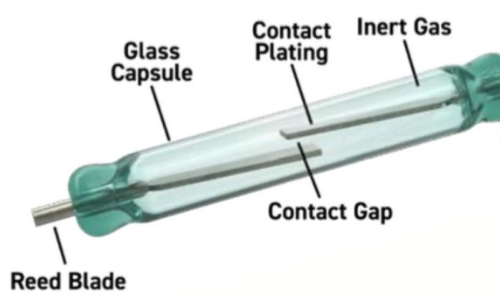
Reed Relays Family Has Added New Member: First Miniature SIP Reed Relay
Reed Relays Family Has Added New Member: First Miniature SIP Reed Relay
March 20 , 2024 in 0
Previously, a distinguished innovator in high performance reed relays, has unveiled its revolutionary Series 219, marking the company’s debut in surface mount high voltage reed relay. The unveiling took place at Productronica, the foremost trade fair for the electronics manufacturing industry, achieving a 5 kV stand off rating necessitated the use of larger, non-SIP (Single-in-Line-Package) relays. However, with the introduction of the new 104 5D reed relay parts, four of these compact components can now occupy the same PCB area that was previously required for a single larger relay, all while maintaining sufficient clearance space between adjacent parts.
Kevin Mallett, Technical Specialist at Pickering Electronics, commented on this advancement: "This marks the debut of the first miniature SIP reed relay capable of withstanding a standoff of up to 5 kV and switching up to 1.5 kV. This innovation is particularly advantageous in applications where a compact design is crucial, as the relays can stack at a mere 6.35 mm. Despite their small size, these relays uphold reliable performance, ensuring effective and safe high voltage switching or control operations."
The Series 104 reed relays find application in various industries, including mixed signal semiconductor testing, cable testing, photovoltaic efficiency monitoring, electric vehicles and charge point testing, mining gas analysis, medical electronics, in-circuit test equipment, high voltage instrumentation, and more. Available in 1 Form A (SPST N.O.), the 5 kV devices come with 5-, 12-, or 24-V coils and optional internal diode protection.
For applications demanding extended operating temperature ranges, the 104HTs are engineered to perform reliably in temperatures ranging from -40 °C to +125 °C. Additionally, custom versions can be tailored to operate in even more extreme temperatures, reaching up to +150 °C.
The introduction of the 104 5-kV version addresses a crucial gap in Pickering's growing high voltage relay range, which now spans from 1 kV to 15 kV, ensuring comprehensive coverage for diverse voltage requirements.
A standout feature of the Series 219 is the incorporation of a diode option in all part numbers. Suppression diodes are strategically integrated within the relay to shield the device driving the relay coil against back electromotive force (EMF), a phenomenon that can arise when the current flow to the coil is disrupted. This proactive measure guarantees the safeguarding of other components on a PCB board, including the coil drive.
Nomenclature
The part numbers follow the format: 104-1-A-x/5D, where the 5 designates Pickering’s ‘Switch No. 5’ subset of 104 relays, specifically the 5kV stand-off types. These relays are housed in ‘Package Type 6’, featuring wider contact pin out spacing compared to other 104 relays. Package Type 2, with coil pins spaced further apart, is available as a special-order option.
The placeholder ‘x’ in the part number is substituted with 5, 12, or 24, depending on the required coil voltage. These coils have resistances of 220Ω, 500Ω, and 3,000Ω respectively.
The 5kV variants are offered with or without an integrated diode across the coil – denoted by the ‘D’ suffix for diode inclusive parts.
Operating temperature ranges from -20 to +85°C, with an option for -40 to +125°C operation available in 104HT variants, featuring higher current coils (125Ω, 500Ω, or 2,500Ω). Custom versions can be engineered to operate up to +150°C.
These 5kV reed relays are envisioned for use in mixed signal semiconductor and electronics testers, cable testing, and instrumentation applications.
An Introduction to Reed Relay Basics
While normally open reed relays are typically the most prevalent configuration, normally closed relays are also available. In these micro reed relays, the blade is biased to remain closed under normal conditions, and the application of a magnetic field is required to open the relay contacts.
The contact bias is achieved by incorporating an internal permanent magnet, which holds the reed switch in a normally closed position. When the relay coil is energized, it counteracts the magnetic field bias, causing the contacts to open. However, if the coil voltage significantly exceeds its nominal voltage (typically greater than 1.5 times the nominal voltage), there is a risk that the contacts may inadvertently reclose.
Not surprisingly normally closed relays are more difficult to manufacture and have higher magnetic interaction due to the bias magnet.
Reed relays are available with changeover switches, featuring both normally closed and normally open contacts within the reed switch. In the absence of a magnetic field, the reed switch's contacts are normally closed, utilizing the blade as a spring bias with a non-ferrous spacer to prevent completing a magnetic circuit. When a magnetic field is applied, the coil field moves the blade to the normally open contact blade, which lacks this spacer. During the transition between these states, neither contact is closed, which is an important consideration in certain applications.
The normally closed position relies on contact pressure generated by the spring bias of the blade. While normally closed reed relays are more complex to manufacture compared to their normally open counterparts, the two contacts, normally closed and normally open, may exhibit different characteristics and stability. Generally, they may have slightly less stable contact resistance than their simpler normally open counterparts. Nevertheless, they fulfill a valuable function in many applications because unlike the use of two normally open reed relays to create a changeover function, they require only one coil drive, and it is mechanically impossible to have both contacts closed simultaneously.
Two Pole Relays Explained:
Reed relays can also be provided as 2-pole relays, housing two reed switches within the same package and controlled by a shared coil drive.
However, it's crucial to note that this reed type relay lack an interlock mechanism between the two poles. It would be unsafe to presume that the two poles operate simultaneously; in fact, the two reed switches function independently. There may exist an operational time difference of 50-250 microseconds between them. Therefore, if one switch fails (e.g., due to contact welding), the other switch will not be affected and will continue to operate independently.
Please check out all of reed relays options in our website to find what you need and contact GUOYUAN ELECTRONICS for more imformation.

 Discrete Semiconductor Products
 Motors, Actuators, Solenoids and Drivers
 RF/IF and RFID
 Integrated Circuits (ICs)
 Inductors, Coils, Chokes
 English