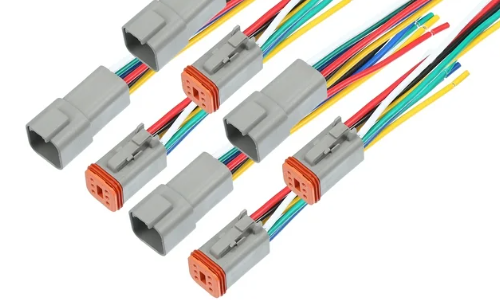
Miniaturized Quick Disconnect Connector For Soldier Systems Has Launched
Miniaturized Quick Disconnect Connector For Soldier Systems Has Launched
March 27 , 2024 in 0
The introduction of this quick disconnect connector further expands our successful lineup tailored for soldier communications. Additionally, it enhances our capability to provide bespoke hybrid solutions and various value added services to military and defense clients. These services include personalized engineering support, rapid prototyping, and integrated cable assembly. Such offerings confer a substantial competitive edge to equipment manufacturers seeking dependable and readily accessible connectivity solutions.
This durable metal connector significantly enhances a soldier's communication capabilities in battlefield scenarios and meets stringent technical requirements through rigorous testing.
Featuring upgraded power contacts with USB 2.0 capabilities and power efficient features, this quick disconnect terminal offers a minimum of 2,000 mating cycles and is waterproof up to IP68, with optional 20m waterproof versions available. It provides flexibility with options for solder, crimp, or PCB terminations, ensuring ease of handling with its robust break away design and integrated cable assembly solutions.
Designed to meet the demands of tactical soldier batteries, power distribution units (PDUs), conformable wearable batteries (CWBs), and C4ISR peripherals, this connector facilitates the transmission of USB 2.0 signals and power. Compliant with open architecture standards such as NATO STANAG 4695, Nett Warrior, and GOSSRA (General Open Structure Architecture), it offers versatility and interoperability.
While the contact arrangement of this data transmission connector is tailored to its specific robust design, it remains compatible with the electrical specifications of standard data transmission protocols, ensuring seamless integration into existing systems.
What Is A QuickDisconnect Fitting?
Quick disconnect fittings (often abbreviated as "QDCs" or "QDs") facilitate rapid and effortless connection and disconnection of fluid lines, commonly known as quick connects or quick release couplings. Typically operated by hand, these fittings serve as convenient alternatives to connections requiring tools for assembly and disassembly. With a diverse array of types available, quick disconnect fittings find application across various industries.
A quick disconnect fitting forms a watertight connection between different tubing types and water filtration systems, enabling swift assembly and disassembly. These fittings enable users to easily insert or remove tubing from another connector, making them invaluable in systems requiring frequent disconnections.
The utilization of quick disconnects significantly enhances user experience by simplifying connection processes and preventing fluid leakage. Engineers can leverage quick disconnects to improve the serviceability of their designs and enhance the value of their products. Moreover, the ease of connection and disconnection offered by these fittings saves valuable time during testing and development phases, benefiting design engineers.
To ensure successful integration, several design considerations must be addressed before specifying a quick disconnect. Due to their complex structure and multiple components within the fluid path, quick disconnect terminal often exhibits higher pressure drops compared to simpler fittings. Designers must verify that the selected fitting can meet the required flow performance for their design. Additionally, it's essential to confirm the pressure limitations of the fitting to ensure it can withstand the maximum service pressures within the application.
Material selection plays a critical role in the performance and longevity of quick disconnect fittings. All construction materials must be compatible with the working fluid and capable of withstanding the operating temperatures of the system.
Before specifying a quick disconnect, designers should ask several important questions:
Does the fitting need to be operable with only one hand?
Is a shut off mechanism required in either or both ends of the connector, or is maximizing flow capacity preferred when connected?
Is "dry breaking" necessary, as discussed later in this tutorial?
Is a non latching disconnect necessary?
Are there multiple fluid lines that require simultaneous connection/disconnection?
Will the disconnect need to operate under vacuum conditions?
What type of tubing or hose will be connected to the quick disconnect?
Addressing these questions will help designers select the most suitable quick disconnect fitting for their specific application requirements.
How Does A QuickDisconnect Fitting Work?
Snap type (ball locking) quick release electrical connector represents the prevailing design in the industry. These connectors incorporate a spring loaded ball locking mechanism, ensuring automatic locking upon the mating of the two halves. With the knurled releasing sleeve facilitating easy handling, disengagement is swiftly achieved by pulling it back, separating the internal and external ends. This rapid release capability proves invaluable in designs necessitating frequent connections across the product's lifecycle due to its user friendly operation. Moreover, these quick disconnects offer the convenience of single handed disconnection. Rated to withstand pressures of up to approximately 500 psig, they ensure reliable performance in various applications.
QuickDisconnect Vs QuickConnect Fittings
In contrast to quick connect fittings, quick disconnect couplings offer the advantage of being easily released and reconnected multiple times. While quick connect fittings provide a permanent seal, quick disconnect (QD) fittings are preferred in applications requiring frequent changes to the system over time. QD fittings are commonly employed in commercial fluid transportation settings, where regular line changes or modifications are necessary. On the contrary, quick connect fittings are best suited for situations where regular maintenance is not required.
QuickDisconnect Fittings:
Quick disconnect fittings are designed to allow for rapid disconnection of fluid or gas lines without the need for tools.
They typically feature a mechanism such as a push button, lever, or twist lock mechanism that enables quick release.
Quick disconnect fittings are commonly used in applications where frequent connection and disconnection are required, such as pneumatic tools, hydraulic systems, and medical devices.
These fittings often provide a secure connection when mated, helping to prevent leaks or spills.
QuickConnect Fittings:
Quick connect fittings are intended to facilitate rapid connection of fluid or gas lines, but may not always allow for rapid disconnection without tools.
They can feature various types of connection mechanisms, including push to connect, compression, or threaded connections.
Quick connect fittings are utilized in a wide range of applications, including plumbing, automotive, HVAC, and industrial processes.
While some quick connect fittings may offer a secure connection, others may require additional measures such as clamps or seals to ensure leak free operation.
In summary, quick disconnect fittings prioritize rapid and tool free disconnection, making them ideal for applications requiring frequent changes or maintenance. Quick connect fittings, on the other hand, focus on facilitating rapid connection, but may not always provide as effortless disconnection and may be used in a broader range of applications beyond frequent disconnect scenarios.
Please check out all of quick disconnect connectors options in our website to find what you need and contact GUOYUAN ELECTRONICS for more imformation.

 Discrete Semiconductor Products
 Motors, Actuators, Solenoids and Drivers
 RF/IF and RFID
 Integrated Circuits (ICs)
 Inductors, Coils, Chokes
 English