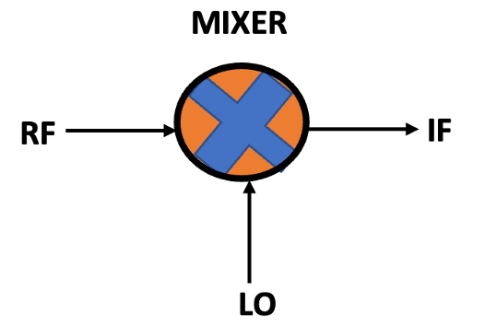
The process of mixing involves combining two input signals: a local oscillator (LO) signal and a radio frequency (RF) signal. When these signals are mixed together, new signals are generated at different frequencies, including the sum and difference frequencies of the original signals. These new frequencies are known as the sum frequency (f_sum = f_RF + f_LO) and the difference frequency (f_diff = |f_RF f_LO|).
RF mixers are crucial components in frequency conversion processes within communication systems. RF frequency mixer enables signal modulation, demodulation, frequency upconversion, downconversion, and frequency shifting. RF mixers are available in various configurations, including passive mixers, active mixers, and integrated mixer circuits, each offering specific advantages and trade offs in terms of performance, cost, and complexity.
Mixer Converts 20 GHz to 80 GHz Frequencies down to IF
mmTron Inc. has unveiled an innovative active mixer designed to facilitate frequency conversion spanning from 20 to 80 GHz. The TMC170D mixer distinguishes itself with its exceptional bandwidth and remarkable feature of maintaining a 0 dB average conversion loss across the entire band, requiring only a 0 dBm LO drive.
Utilizing InP semiconductor technology, this mixer achieves comprehensive RF and LO coverage from 20 to 80 GHz, with an IF range extending from kHz to 70 GHz. The mixer's low IF frequency limitation is solely determined by the size of an external blocking capacitor. Notably, the TMC170D incorporates an integrated LO amplifier, eliminating the necessity for an external LO buffer amplifier while demanding only a 0 dBm drive.
Employing a triple balanced architecture encompassing LO, RF, and IF, this mixer ensures outstanding harmonic performance, boasting RF to IF isolation exceeding 80 dBc. All ports are meticulously matched to 50 Ω, delivering VSWR better than 1.5:1.
Operating the active mixer requires three bias voltages: +5 V drawing 90 mA, +7 V drawing 90 mA, and –3 V drawing 55 mA.
The broad frequency coverage of the TMC170D renders it highly suitable for applications in electronic warfare (EW) and advanced mmWave instrumentation systems.
The burgeoning utilization of the mmWave spectrum necessitates signals intelligence (SIGINT) receivers capable of covering the extended spectrum swiftly to detect and classify signals. With its expansive bandwidth spanning RF, LO, and IF, the TMC170D offers versatile frequency planning options and simplifies receiver designs for software defined radios utilized in drones and portable SIGINT systems.
Instrumentation systems such as vector network analyzers (VNA) must extend their capabilities to provide precise measurements in the higher mmWave bands. The TMC170D serves as an ideal solution for frequency extenders, enabling wide bandwidth front ends to be integrated directly into VNAs and spectrum analyzers.
Available in die form, the TMC170D measures 1.6 mm (input to output) x 1.09 mm (width) x 75 µm (thickness). Its bond pad and backside metallization are Au based, ensuring compatibility with standard wire bonding and high conductivity epoxy die attach processes.
The Different Types of RF Mixers
RF mixers come in various types, each suited for different applications and offering specific advantages. Here are the main types of RF mixers:
Passive Mixers: These mixers use passive components like diodes or FETs (Field Effect Transistors) to achieve frequency mixing. They are simple in design and typically offer low conversion loss. However, they may suffer from higher levels of noise and require higher LO power.
Active Mixers: Active mixers incorporate active components such as bipolar transistors or CMOS (Complementary Metal Oxide Semiconductor) technology in addition to passive components. They provide better performance in terms of conversion gain, noise figure, and linearity compared to passive mixers. Active mixers are often used in high performance applications where low noise and high linearity are essential.
Double Balanced Mixers: These mixers utilize a double balanced configuration, which helps to suppress unwanted mixing products and spurious signals. They offer good port to port isolation and can handle higher input power levels compared to single balanced mixers.
Single Balanced Mixers: Single balanced mixers are simpler in design compared to double balanced mixers but offer lower port to port isolation. They are suitable for applications where lower cost and simplicity are priorities.
Image Reject Mixers: These mixers are designed to reject the image frequency, which is an unwanted mixing product that appears at the same frequency as the desired RF signal but on the opposite side of the LO frequency. Image reject mixers are commonly used in applications where image rejection is critical, such as in superheterodyne receivers.
Subharmonic Mixers: Subharmonic mixers operate by mixing the RF signal with a subharmonic of the LO frequency. They are used in applications where LO frequency generation is challenging or costly. Subharmonic mixers offer advantages such as reduced LO power requirements and simplified LO frequency generation.
Mixer ICs (Integrated Circuits): Mixer ICs integrate the mixing function along with other RF components such as amplifiers, filters, and LO generation circuitry onto a single chip. They offer compactness, ease of integration, and improved performance in many applications.
Each type of RF mixer has its own set of characteristics and is selected based on factors such as desired performance, cost, power consumption, and the specific requirements of the application.
What Are The one of a kind Varieties of RF Mixers?
RF mixers come in numerous sorts, every with its own particular blessings and drawbacks. A number of the special styles of RF mixers include single balanced mixers, double balanced mixers, triple balanced mixers, picture reject mixers, up conversion mixers, down conversion mixers, passive mixers, energetic mixers, sub harmonic mixers, and diode mixers.
What are the Benefits and Downsides of Unmarried Balanced Mixers?
Unmarried balanced mixers offer appropriate isolation between enter and output ports, decreasing sign leakage and maintaining sign integrity. But, they may show off better conversion loss and their overall performance may be suffering from variations in nearby oscillator energy and segment balance.
GUOYUAN ELECTRONICS might offer a range of rf signal mixer with different specifications and features. You can visit our website or contact us directly to inquire about rf mixer circuit offerings, specifications, pricing, and any other details you may need to make an informed decision.

 Discrete Semiconductor Products
 Motors, Actuators, Solenoids and Drivers
 RF/IF and RFID
 Integrated Circuits (ICs)
 Inductors, Coils, Chokes
 English