New Product of Solenoid Valves Market : New Emerson High Flow Solenoid Valve
Emerson has introduced the new ASCOTM Series 327C solenoid valve, which boasts a direct-acting, high flow design offering a superior flow to power ratio compared to similar valves. The Series 327C features a balanced poppet construction that enables high flow rates with minimal power consumption, making it ideal for power plants, refineries, and chemical processing facilities.
Such facilities often have hundreds or even thousands of valves integrated into their systems. A single malfunctioning valve can disrupt critical gas and fluid flows, affecting process quality and causing unscheduled downtime and additional maintenance.
The ASCO Series 327C is designed for reliability and durability, enhancing operational efficiency and ensuring process certainty. It features a unique two-layer dynamic seal technology that provides low friction and excellent resistance to stiction, ensuring dependable valve operation in temperatures ranging from –60 to 90°C. Additionally, the valve is SIL (Safety Integrity Level) 3 capable, indicating a high level of performance integrity and a very low risk of failure throughout its lifecycle.
How Solenoids Work
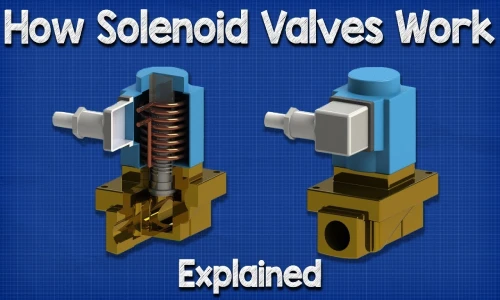
At the core of the valve is a solenoid, comprising two primary components: a helical copper coil and a movable ferromagnetic core, also known as the plunger or armature. The coil wraps around the core to form a cylindrical shape.
In its resting state, the plunger extends outside the coil, held in place by spring tension. When the solenoid is powered, an electric current flows through the coil, generating a magnetic field that acts as an electromagnet. This magnetic field attracts the armature to the center of the coil, opening a port in the valve and allowing media to flow through.
When the power is switched off, the electromagnet is deactivated, and the spring pushes the plunger back to its original position, closing the valve port.
For the system to function correctly, the magnetic force generated by the coil must exceed the combined forces of the spring tension, the friction of moving the armature, and the hydraulic pressure of the media.
Powering the coil on and off converts electrical energy into mechanical or linear energy, moving the plunger up and down.
While there are various mechanical applications of this design, such as in car starters, latches, solenoid valves, and switches, the fundamental design, based on electromagnetism, remains consistent.
Differences Between AC And DC Solenoid
Despite their similar design, there are two types of solenoids: AC and DC solenoids, named after the type of current they use.
In a DC solenoid, the operation is straightforward. When the coil is energized, it generates a magnetic force that pulls the armature, opening the valve port. Cutting off the power de-energizes the coil, and the spring pushes the armature back, closing the valve.
AC solenoids, however, operate differently. AC current alternates, changing polarity several times per second, creating a sinusoidal wave.
If you plot the AC current on a graph, you'll see two periods per cycle where the current is zero. This means the coil is continuously energized and de-energized, causing the magnetization to switch on and off. Consequently, the spring pushes the plunger out whenever the magnetization is off.
This results in intense vibrations, which place significant stress on the coil and can cause it to overheat, potentially leading to burnout.
Differences In Performance
Apart from the structural/design differences between the two types of solenoids, they have several performance variations in the following areas.
Power Requirements
AC solenoids have an advantage over their DC counterparts in terms of power requirements. Initially, they consume high levels of energy to generate strong peak currents in the coils to open the valve.
While this high initial energy consumption might seem disadvantageous, it is necessary because the initial magnetic force on the plunger must be strong enough to overcome the hydraulic pressure from the media, friction, and spring tension.
Once the valve is open, the current (and magnetic force) required to keep the armature in position is relatively low. AC solenoids operate this way, with the current dropping after the valve opens, thereby delivering sufficient opening force initially and then conserving energy, which helps reduce overall power consumption.
In contrast, DC solenoid valves exhibit a gradual increase in power consumption from the start, resulting in a slower valve opening. After opening, these devices consume a constant amount of current, which is more than what is required to keep the valve ports open. This results in significant energy wastage compared to AC solenoids.
However, the design of DC solenoids can be improved with external circuits, such as a capacitor and resistor in parallel. In this setup, charging the capacitor via the coil spikes the current, providing enough power to open the valve quickly. The resistor then limits the current passing through the coil once the capacitor is fully charged.
Despite this improvement, the setup still wastes energy, as the excess energy is dissipated as heat in the resistor instead of being used efficiently.
Noise and Vibrations
AC solenoids have some drawbacks, particularly in terms of noise and vibrations. Even though their design incorporates shading rings to mitigate this issue, there is still a risk of vibrations if this component fails. When that happens, the solenoid can produce a buzzing noise and sustain damage.
In contrast, DC solenoids do not have this risk because the current does not change polarity, eliminating the possibility of buzzing.
Eddy Currents
Another major drawback of AC solenoids is the generation of eddy currents and magnetic hysteresis losses caused by the induced EMF in the plunger. These factors lead to power losses, reducing the solenoid's efficiency. However, a crucial design improvement involves changing the armature material from iron to silicon steel sheets, which significantly reduces these losses.
DC solenoids, on the other hand, do not produce eddy currents since the current flows in a single direction.
Operating Time
With AC, the operating time is not constant because it varies with the frequency of operation, which also affects the coil’s heat buildup.
In contrast, DC solenoids have a constant operating time. Regardless of the frequency, the operating time remains the same because the current flows in one direction.
Service Lifetime
The service life of both solenoid types depends on the wear and tear (friction) between the plunger and the valve pipe or guide. AC solenoids may experience faster wear if they start buzzing.
Excitation Current
In a DC solenoid, the excitation current is determined by the coil's internal resistance and voltage, and it remains constant regardless of the stroke. When energized, the coil pulls the plunger to open the valve, progressively reducing the size of the air gap and thereby minimizing magnetic resistance.
According to Ohm’s law, magnetic flux is inversely proportional to magnetic resistance when the field current is constant. As the plunger moves inward, the magnetic flux increases, enhancing the coil's attractive force. This relationship indicates that the strength of the magnetic flux is influenced by the position of the plunger.
Conversely, AC solenoids exhibit variations in excitation current depending on the stroke, with significant differences between pre- and post-armature closing processes. During startup, these solenoids may experience a current spike up to 15 times the excitation current.
In AC solenoids, the magnetic flux is influenced by AC voltage and frequency, while the magnetic resistance fluctuates before and after the armature closes due to changes in the air gap.
GUOYUAN ELECTRONICS might offer a range of solenoid with different specifications and features. You can visit our website or contact us directly to inquire about open frame solenoid offerings, specifications, pricing, and any other details you may need to make an informed decision.

 Discrete Semiconductor Products
 Motors, Actuators, Solenoids and Drivers
 RF/IF and RFID
 Integrated Circuits (ICs)
 Inductors, Coils, Chokes
 English