The use of electromechanical systems is growing in various industrial machinery applications due to the precision and reliability they offer. In many instances, they are replacing the traditional hydraulics used in these machines. This means hydraulics are converting to electric actuators.
While hydraulics will remain the preferred technology for many applications, it is crucial to understand how to transition to electromechanical systems (such as electric actuators) where applicable. This knowledge is essential to ensure optimal machine performance when converting from one technology to the other.
In a company hosted webinar on converting from hydraulic to electric actuators, it is explained that key steps for a successful conversion include determining the application's loads and forces, as well as defining its required motion profile and cycle rate.
Factors to Consider Before Converting to Electric
When considering replacing a hydraulic system with an electromechanical one, several factors must be considered to ensure the feasibility of the conversion.
One of the primary factors to assess is the available space for the system. Hydraulics are very power-dense, leading to machine designs that optimize for a compact footprint. Consequently, there may not be enough room for an electric actuator and its accessory components.
Electric actuators typically require more space than hydraulic cylinders due to their longer and wider dimensions. Additionally, the mounting design work needs to be taken into account.
Force levels and stroke length must also be considered, particularly concerning the available space. Although modern electric actuators can achieve high forces, they are not as power-dense as hydraulics, meaning they require more space to generate forces comparable to those of the hydraulic cylinders they replace.
Therefore, a thorough understanding of the machine design and its intended use is crucial for determining if an electromechanical system will be suitable for the application.
What is an Electric Actuator?
An electric actuator, or an electric cylinder, is a mechanical device that converts electricity into kinetic energy, either in a linear or rotary motion. It automates dampers or valves to enhance process efficiency and complexity. Electric actuator designs are tailored to their specific tasks within the intended processes, leading to variations in dimension and size.
The push for increased decentralization in automation technology has expanded the applications for electric actuators. New process controllers can now be integrated with last-generation electric actuators, making it easier to meet updated automation standards. Additionally, the inclusion of failsafe capabilities ensures that user control is maintained even during power loss, making electric actuators safer than ever.
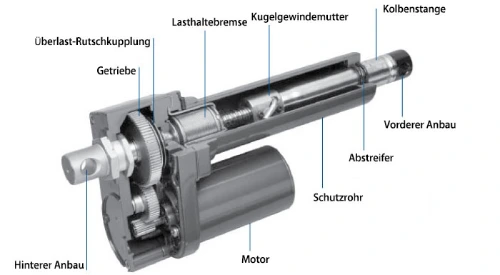
Main Components of an Electric Actuator
The motor of an electric actuator can operate on various voltages and is utilized across numerous industries. The most common voltages for single-phase motors include:
115 VAC
24 VAC
12 VDC
24 VDC
208 VAC
230 VAC
Additionally, three-phase motors often use voltages of 230 VAC and 460 VAC.
An actuator’s brake, mounted on top of the motor, prevents the valve from being forced open by locking the motor rotor in place when not in use.
The motor start capacitor is another crucial component of an electric actuator with an AC motor. It provides the necessary power to start the motor. In contrast, electric actuators with DC motors do not require a capacitor.
The final critical components of an electric actuator are the two single-pole, double-throw (SPDT) end-of-travel limit switches. One switch is for the closed position and the other for the open position, ensuring the appropriate electrical contacts are provided in the immediate, closed, and open positions.
Applications: Where are Electric Actuators Used?
Electric actuators are widely utilized across various industries, particularly in applications involving the automation of valves, pumps, and motors. Their primary function is to automate industrial valves, making them integral to many types of technical process plants. Some of the key industries and applications where electric actuators are commonly used include:
Oil and Gas Plants: From upstream extraction to midstream transportation and downstream refining, electric actuators play a crucial role in managing the flow and pressure of fluids.
Wastewater Treatment Plants: They are essential for controlling the valves that regulate water flow and ensure the proper treatment of wastewater.
Power Plants: Electric actuators help in the operation of various control valves, contributing to the efficient generation and distribution of power.
Food and Beverage Plants: In these plants, actuators automate processes that require precise control over flow and pressure, ensuring the quality and consistency of products.
Farming and Agricultural Plants: They are used in irrigation systems and other agricultural machinery to automate and optimize processes.
Pulp and Paper Plants: Electric actuators manage the valves that control the flow of chemicals and water, which are crucial in the manufacturing of paper products.
In all these applications, electric actuators contribute to increased efficiency, safety, and precision, making them indispensable components in modern industrial automation.
Common Questions and Answers
How is an AC two-position electric actuator wired?
The terminal strip connects the wires using several pins. Pin 1 is typically the neutral line, while Pins 2 and 3 serve as the hot lines for the closed and open positions, respectively. A relay, such as a control switch, divides the hot line.
What if the valve is not completely closed or opened?
To adjust the cams for full closure or opening of the valve, loosen the set screw and rotate the cams to the desired position. This adjustment allows the actuator to rotate slightly further, ensuring the valve is fully open or closed. Installers and maintenance technicians repeat this process in both the closed and open positions until satisfactory results are achieved.
Do you need to apply steady power to an electric actuator?
Power is always supplied to either pins 1 and 2 or pins 1 and 3. Limit switches cut power to the motor once the actuator reaches the required position, whether it be closed or open.
Do you really need a start capacitor and a brake on an electric actuator?
Yes, an AC voltage electric actuator requires a motor start capacitor to provide the initial power needed to start the motor. In the closed position, an energized brake holds the motor in place. Without a mounted brake, there is a risk that the force of the media within the pipes will slightly open the valve, particularly in butterfly valves and dampers. The actuator will detect the open valve and rotate it back to the fully closed position, causing repeated oscillation that can eventually damage the motor and actuator.
GUOYUAN ELECTRONICS might offer a range of fast electric actuator with different specifications and features. You can visit our website or contact us directly to inquire about heavy duty electric cylinder offerings, specifications, pricing, and any other details you may need to make an informed decision.

 Discrete Semiconductor Products
 Motors, Actuators, Solenoids and Drivers
 RF/IF and RFID
 Integrated Circuits (ICs)
 Inductors, Coils, Chokes
 English