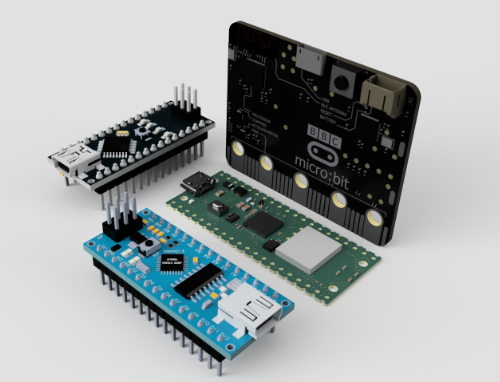
Recently, Raspberry Pi LTD introduced the Raspberry Pi RP2350, a microcontroller designed for use with the Raspberry Pi Pico 2 and other RP2350-based products [h/t Hackaday]. However, a hardware issue was soon identified involving the onboard pull-up resistors, which exhibit faulty voltage control. Specifically, when GPIO pins are set to 3.3 volts, they fail to return to 0 volts and instead remain stuck at 2.1 volts due to unintended latching behavior that prevents the GPIO pins from discharging properly.
Ian Lesnet, known as Bus Pirate on Mastodon, was the first to discover this bug. It has since been documented in the official RP2350 datasheet, which notes that the problem affects pull-up SWD pads but not QSPI pads, as the latter do not have the defective circuitry. Additionally, USB PHY pull-down resistors are not affected by this issue.
For those dealing with this problem, there are two potential solutions. Raspberry Pi LTD suggests enabling an input buffer before a read and disabling it afterward. Alternatively, Lesnet's approach involves adding external pull-down resistors to the board, which increases its size but effectively addresses the issue. The choice between these solutions depends on whether you need to use the internal pull-down resistors as they are or if you prefer the external fix offered by Bus Pirate.
Introduction to Microcontroller
A microcontroller, often abbreviated as μC or uC, is a single-chip microcomputer designed using Very Large Scale Integration (VLSI) technology. It is also referred to as an embedded controller. The market offers a wide array of microcontrollers with varying word lengths, including 4-bit, 8-bit, 64-bit, and 128-bit options. These compact computing devices are specifically engineered to manage the operations of embedded systems found in a diverse range of applications, such as office equipment, robotics, household appliances, automotive systems, and various other electronic devices. A microcontroller typically includes essential components such as memory, peripheral interfaces, and, most crucially, a processing unit. They are predominantly utilized in devices that require some level of user-applied control.
Microcontroller Basics
Electrical devices that store, measure, display, or compute information typically contain a microcontroller chip. The fundamental components of a microcontroller include:
CPU: The central processing unit (CPU) is the microcontroller's brain. It is responsible for fetching data, decoding it, and executing tasks. The CPU integrates all microcontroller components into a cohesive system and processes instructions from the programmable memory.
Memory: A microcontroller's memory functions similarly to a microprocessor's. It stores programs and data. Microcontrollers come equipped with a certain amount of ROM or RAM (such as EPROM, EEPROM, etc.) or flash memory for storing program code.
Input / Output Ports (I/O Ports): These ports are used to interface with or control various devices, including printers, LCDs, LEDs, and more.
Serial Ports: These provide a serial interface between the microcontroller and other peripherals, such as parallel ports.
Timers: Microcontrollers may have one or more built-in timers or counters that manage all counting and timing operations. Timers are used for counting external pulses and performing tasks like pulse generation, clock functions, frequency measurement, modulation, oscillation creation, and more.
ADC (Analog-to-Digital Converter): The ADC converts analog signals into digital signals. It requires analog input and the resulting digital signals can be used in various digital applications, such as measurement devices.
DAC (Digital-to-Analog Converter): This component performs the opposite function of the ADC. It is commonly used to control analog devices like DC motors.
Interpret Control: This controller is used for providing timed control to a running program. Interpretation can be either internal or external.
Special Functioning Block: Some microcontrollers designed for specific applications, such as space systems or robotics, include this special block. It has additional ports to perform unique operations.
Types of Microcontroller
Microcontrollers are categorized based on their memory, architecture, bit size, and instruction sets. Here's a brief overview of the types:
Bit Size:
8-bit Microcontrollers: Perform logic and arithmetic operations. Intel 8031/8051 are examples of 8-bit microcontrollers.
16-bit Microcontrollers: Offer greater accuracy and performance compared to 8-bit. An example is the Intel 8096.
32-bit Microcontrollers: Used in automated devices like office machines and medical implants. They require 32-bit instructions for operations.
Memory:
External Memory Microcontrollers: Lack all functional blocks on a single chip, like the 8031, which doesn't have on-chip program memory.
Embedded Memory Microcontrollers: Have all functional blocks on a single chip, such as the 8051, which includes program and data memory, counters, timers, interrupts, and I/O ports.
Instruction Set:
CISC (Complex Instruction Set Computer): Allows complex operations with a single instruction.
RISC (Reduced Instruction Set Computer): Reduces operation time by shortening the clock cycle per instruction.
Memory Architecture:
Harvard Memory Architecture Microcontroller: Separates program and data memory.
Princeton Memory Architecture Microcontroller: Uses a single memory space for both program and data.
8051 Microcontroller:
A widely used family, originally developed by Intel. The 8051 is known for its groundbreaking impact in the field. It has variants like the 8052, which includes 3 timers and 256 bytes of RAM, and the 8031, which lacks ROM but can interface with external ROM.
PIC Microcontroller:
From Microchip Technology, these are popular for their success in the 8-bit market, thanks to constant upgrades and the inclusion of necessary peripherals. They are favored by hobbyists and industrialists for their affordability, wide availability, and programming capabilities.
AVR Microcontroller:
Advanced Virtual RISC, an 8-bit RISC microcontroller with a Harvard architecture, known for its on-chip flash memory. Developed by Atmel, AVR microcontrollers are recognized for their efficiency and integration of SRAM, Flash, and EEPROM on a single chip.
ARM Microcontroller:
A 32-bit RISC architecture designed by ARM Ltd., known for its power efficiency in mobile electronics. ARM processors are characterized by their single-cycle operation, 16×32 bit register file, load/store architecture, and fixed 32-bit instruction width.
Each type of microcontroller is tailored to meet specific requirements of embedded systems, from simple to complex applications.
GUOYUAN ELECTRONICS can offer a wide range of ic microcontroller with different specifications and features. You can visit our website or contact us directly to inquire about pic microcontroller, specifications, pricing, and any other details you may need to make an informed decision.

 Discrete Semiconductor Products
 Motors, Actuators, Solenoids and Drivers
 RF/IF and RFID
 Integrated Circuits (ICs)
 Inductors, Coils, Chokes
 English