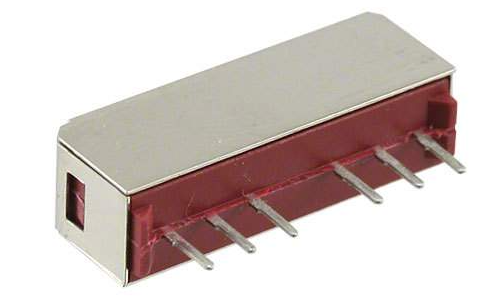
HF (high frequency) and RF (radio frequency) relays utilise radio signals to perform switching functions. These relays are found in lots of applications, including computers, testing equipment and radio broadcast systems. They're needed to handle the high voltages that often come with high frequencies, which standard relays cannot manage. RS have HF & RF relays from industry-leading brands such as Panasonic, Omron, TE Connectivity and Teledyne.
What are HF and RF Relays Used for?
As the frequencies employed in electronic devices continue to rise, the significance of high-frequency relays becomes paramount for effectively isolating circuits in environments with elevated frequencies. These relays find application in scenarios where electronic signals operate at exceptionally high frequencies. This encompasses a wide range of uses, from communication equipment to computers and industrial machinery.
RF (Radio Frequency) relays, in particular, play a crucial role in radio applications, frequently utilized in testing equipment and radio broadcasting devices. Their essential function lies in activating distinct circuit systems within radios, facilitating both transmission and reception processes.
Types of HF and RF Relays
High frequency and RF relays can be built with special features. For instance, they can be made flux resistant, immersion cleanable, wash tight or designed for low power consumption. Solid-state versions of these relays are also available.
Is Higher Frequency Rf Relay Better Than Lower Frequencyrf Relay?
The suitability of a higher or lower frequency RF relay depends on the specific requirements of the application. Here are some considerations:
Application Requirements: The choice between higher and lower frequency RF relays depends on the frequency range of the signals involved in the application. Different applications may require relays optimized for specific frequency bands.
Signal Integrity: Higher frequency RF relays are designed to handle signals with faster oscillations. If your application involves high-frequency signals, a relay optimized for those frequencies would likely offer better signal integrity and performance.
Cost and Size: Higher frequency RF relays often come with more advanced technology and specifications, and as a result, they may be more expensive. Additionally, higher frequency components may be more challenging to manufacture with smaller sizes. Consider the cost constraints and size limitations of your application.
Compatibility: Ensure that the chosen RF relay is compatible with the overall system and other components. Some systems may be designed to work optimally with specific frequency ranges.
Power Handling: Higher frequency relays may have different power handling capabilities. It's essential to choose a relay that can handle the power levels associated with your application.
In summary, there is no universal rule that higher frequency RF relays are always better than lower frequency ones. The choice depends on the specific needs and characteristics of the application in question.
What is Control Relay?
A control relay, commonly referred to as simply a Relay, functions as an electromagnetic switch. It permits the flow of electrical current through a conductive coil, thereby enabling the opening or closing of a switch. Additionally, a control relay serves the purpose of safeguarding the circuit current. The utilization of a control relay eliminates the need for manual intervention in altering or isolating the state of an electric circuit.
In contemporary electronic devices, control relays play a pivotal role. These electronic components power various devices, including but not limited to motors, power plants, power supply systems, and transistors. Their significance extends to diverse applications within today's electronic landscape.
Different Types of Control Relays
Control relays come in various types, each distinguished by its operating principle and structural features:
Solid State Relays: Utilizing solid-state components, these relays perform switching operations without any moving parts.
Contactor: A sizable relay designed to manage substantial electrical power by facilitating the switching of contacts.
Electromagnetic Relays: Constructed with electrical, mechanical, and magnetic components, electromagnetic relays consist of operating coils and mechanical contacts. When the coil is activated by a supply system, the mechanical contact either opens or closes. Supply systems can be categorized into two types: AC (Alternating Current) and DC (Direct Current).
Thermal Overload Protection Relay: Operating on the principle of the thermal effect of electrical energy, this relay responds to excessive current flow in the circuit. When an increase in temperature occurs, the bimetallic strip triggers the circuit to open.
Understanding the distinctions among these control relay types enables users to choose the most suitable one for specific applications and operational requirements.
Understanding Contact Type of a Relay
Every Control Relay is characterized by a specific contact type, such as SPST-NO, but understanding what this designation means is crucial.
"Poles" refer to the number of circuits controlled by the switch, while "Throws" indicate the number of positions the switch can adopt.
Single Pole Single Throw (SPST): This type has two terminals that can either be connected or disconnected. With two additional terminals for the coil, a total of four terminals is present in such a relay.
Single Pole Double Throw (SPDT): This relay includes a common terminal that can connect to either one of two others. With two terminals for the coil, the total count is five. Regardless of the coil's state, either 'A' or 'B' remains connected while the other requires the coil to be powered.
Double Pole Single Throw (DPST): Equivalent to two SPST relays activated by a single coil, this relay features a total of six terminals, including two for the coil.
Double Pole Double Throw (DPDT): This type equals two SPDT relays activated by a single coil, resulting in a total of eight terminals, including two for the coil.
Understanding these designations aids in selecting the appropriate control relay based on the required functionality and the number of circuits to be controlled.
NO (Normally Open) contacts permit the flow of current when the relay is energized. In other words, when voltage is present, the NO contact closes, allowing current to pass through. On the contrary, NC (Normally Closed) contacts enable current flow when the relay is not energized. Unlike NO, the NC contact opens, interrupting the current flow.
Additionally, "Change Over" (CO) is synonymous with a "Double Throw" (DT) relay. Both terms refer to a relay with a common terminal that can connect to either of two other terminals, providing a switching capability between two circuit paths.
GUOYUAN ELECTRONICS offers a variety of connector series so you can find the power connectors you need. All power connectors boast low contact resistance, an environmentally conscious feature that saves energy by reducing the amount of energy converted to heat during operation.

 Discrete Semiconductor Products
 Motors, Actuators, Solenoids and Drivers
 RF/IF and RFID
 Integrated Circuits (ICs)
 Inductors, Coils, Chokes
 English