In 2023, the global market for PCIe Switch Chips was valued at approximately $1,005 million. It is projected to grow to $2,381 million by 2030, reflecting a compound annual growth rate (CAGR) of 12.5% from 2024 to 2030.
Leading global manufacturers of PCIe switching chips include Broadcom, Microchip, Texas Instruments, ASMedia, Diodes, and ON Semiconductor. The top three manufacturers control around 72% of the global market share, with Broadcom being the largest, holding approximately 44%.
China is the leading producer of PCIe switch chips, contributing nearly 46% of the global production. North America and Taiwan, China, follow with market shares of 16% and 15%, respectively. Regarding product types, PCIe 3.0 is the most prevalent, accounting for 47% of the market. Servers represent the largest application segment, making up 65% of the market share.
Top 3 Uses for PCI Express Switches
Port Expansion and Fanout
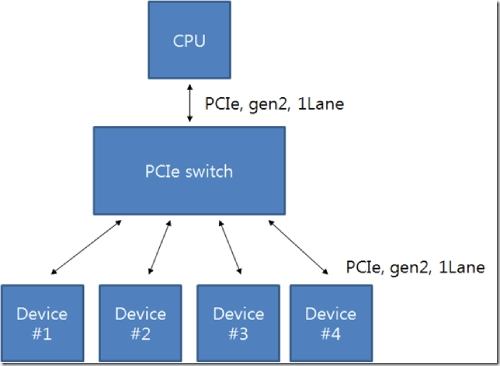
Port expansion and fanout refer to the need for more PCIe connections in a design than what is natively provided by the CPU, SoC, MCU, Southbridge, or multi-I/O controller. For instance, Intel’s x86 Core i7 and Atom CPUs often come with two or three PCIe ports, which can be sufficient for many applications. However, ARM-based SoCs like those from Freescale’s i.MX series may only provide a single PCIe port on some devices, limiting connectivity options.
To address this limitation, a PCIe switch can be used to expand the number of available PCIe connections. For example, a PCIe switch like Pericom Semiconductor’s PI7C9X2G612GP can take one upstream PCIe Gen2 port and split it into five downstream ports, effectively increasing the fanout. This approach allows for greater flexibility in system design, accommodating a wider range of ports and features to meet specific needs.
Practical examples of fanout enhancement using PCIe switches include host bus adapters, where the CPU or SoC leverages the switch to communicate with both local resources and bus or backplane-based resources. Additionally, a PCIe switch can be placed between a CPU and multiple memory controllers, such as those managing RAID arrays or SSDs. This setup allows the system to switch between different memory arrays or banks, increasing storage density or enhancing speed through techniques like memory striping, where data is alternated between memory banks for faster access.
For instance, a multi function printer that utilizes a PCIe switch to manage connections between the SoC, the scan and print engines, and four PCIe endpoints. This configuration enables efficient communication and resource management across the various components of the device.
Lane Swapping
Let's skip the obvious analogy and get straight to the point: lane swapping is similar to converting between different PCIe configurations, much like how Endian conversion works or how old-style connector gender changers were used.
Imagine you have a drawer full of USB cables, but none of them have the right connector for your device. PCI Express host adapters, like those in CPUs, often come with a fixed configuration, such as a single x8 lane. But what if your setup requires two x4 lanes or perhaps eight x1 lanes (one lane per device)? A PCIe switch can handle this "lane swapping" for you, allowing you to convert and configure the lanes to match your specific needs.
Bridging, Conversion, and Advanced Functions
In addition to port expansion and lane swapping, PCIe switches offer several advanced features that benefit designers. It also supports isochronous traffic on specific ports, ensuring guaranteed latency for time-sensitive data, such as that used in network data planes. These advanced capabilities are key reasons to opt for a PCIe switch.
While most PCIe switches are designed to move data between ports, some go further by incorporating packet routing functions. These switches can use routing criteria provided by the local host to ensure that only specific types of packets are routed between ports. This capability elevates the switch beyond mere fanout enhancement, enabling it to function as an intelligent local controller.
A variation of this functionality is found in bridge/switch devices, referred to as “SWIDGEs”. For example, the PI7C9X442SL is a SWIDGE that bridges between USB 2.0 and PCIe 2.0. This device can transform a system with limited I/O or resources into a multi-port multiplexer, enabling data transfer between different bus types.
The device shown in Figure 4 serves as a fanout enhancer with one upstream and two downstream PCIe 2.0 ports. Additionally, it includes four USB 2.0 host controller ports, effectively converting a single PCIe x1 lane CPU into one that supports two PCIe and four USB 2.0 ports. Importantly, no USB 2.0 drivers or software are required when the switch/bridge implements USB 2.0.
These switches also feature intelligent routing functions, including non-blocking bridging and “store and forward” packet switching, all while minimizing CPU intervention. Together, the switch/bridge acts as a versatile I/O controller with DMA capabilities, achieving up to 16 Gbps of throughput when all ports are fully utilized.
Beyond USB 2.0, PCIe switches can also facilitate other I/O conversions, such as between PCIe and serial interfaces like RS-232, RS-422, and RS-485. For example, Pericom’s PI7C9X7952 enables conversion between PCIe 1.1 and serial ports through its integrated dual UART blocks. The range of possible configurations and conversions with PCIe switches is virtually limitless.
GUOYUAN ELECTRONICS can offer a wide range of switch pcie with different specifications and features. You can visit our website or contact us directly to inquire about pcie switch ic, specifications, pricing, and any other details you may need to make an informed decision.

 Discrete Semiconductor Products
 Motors, Actuators, Solenoids and Drivers
 RF/IF and RFID
 Integrated Circuits (ICs)
 Inductors, Coils, Chokes
 English