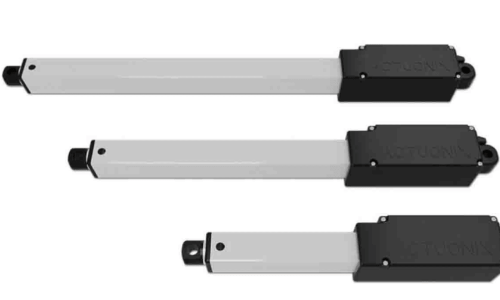
The L 239 micro actuator is a precision engineering marvel designed to excel in applications with restricted spatial parameters or where the utmost precision demands decoupling from the drive system. Distinguished by its exceptional standard force rating of 200 N, which can be further augmented, it outperforms conventional pushers.
Equipped with a DC gear motor with encoder and 2 phase gear motor combination or available as a direct drive DC with encoder or 2 phase stepper motor variant, the L 239 offers versatile motorization options. These drives seamlessly integrate with a ground preloaded re circulating ball screw boasting pitches of 1 mm or 2 mm, ensuring precise control.
Capitalizing on its robust construction and high pushing force capabilities, the L 239 achieves remarkable speeds and resolutions to meet stringent performance criteria. With a generous travel range of 52 mm (2"), safeguarded by two integrated mechanical or optional hall limit switches, it mitigates risks of accidental overtravel. Furthermore, all critical components are meticulously crafted from stainless steel, ensuring longevity and reliability.
What is a Micro Linear Actuator?
In simple terms, Micro Linear Actuators are compact devices with a limited range of motion. They're smaller in size compared to regular linear actuators and typically offer strokes ranging from a few millimeters to around 50mm. Due to their compact nature and shorter strokes, they generate less force than traditional linear actuators. This is because the power source, usually a motor, needs to be smaller, resulting in reduced force output for the micro actuator.
Where are Micro Linear Actuators Used?
Many overlook the fact that technology encompasses anything that enhances our daily lives. From humble tools like pencils and chairs to cutting edge supercomputers, they all fall under the umbrella of technology. We're living in an era where technological advancements are happening at an unprecedented pace across all fields of science and engineering, making it a thrilling time to exist.
Did you know that current technology has the potential to automate around 45% of the tasks people are paid to do? This translates to roughly $2 trillion in annual wages. Recent advancements in micro linear actuators are key contributors to the progress of automation technology.
Linear micro actuators are fundamental components in various devices and machinery, facilitating movement along a straight path. Micro linear actuators operate on the same principle but on a smaller scale.
Are you intrigued and eager to delve deeper into the world of micro electric actuator? Do you want to understand how to integrate them into your next project? Then sit back, relax, and keep reading, as we're about to explore everything you need to know to set your projects in motion with linear actuators.
Micro Actuator Types
An actuator serves as a mechanical mechanism employed to initiate movement or regulate components within a machine or stationary object. Without actuators, achieving autonomous motion would be unattainable. At its core, an actuator necessitates two fundamental elements for controlled movement: a control signal and an energy source.
The control signal can range from a simple button press to an automatic switch activated by external conditions. Meanwhile, the energy source empowers the movement to execute tasks. Actuators are classified based on their energy source, the direction of movement they facilitate, and their size or power. Common micro actuator types encompass:
Pneumatic
Electromechanical
Linear motor
Thermal
Magnetic
Mechanical
Human powered
They can further be delineated by their conversion mechanism:
Circular (rotary movement)
Linear (straight pull and push movement)
Moreover, they vary by size and power, ranging from industrial strength actuators to softer variants and micro actuators.
Different types of actuators are selected based on their intended function and role within a controlled system. For instance, industrial strength hydraulic cylinder linear actuators are employed to tilt and maneuver the bucket of excavators, or lift the bed of dump trucks for efficient unloading.
How do Linear Actuators Work?
The advent of linear actuators heralded a revolution in modern society comparable to the significance of the wheel in ancient times. While advancements have refined their design, the underlying principles governing the operation of linear actuators have remained steadfast.
Electric linear actuators stand out as the most prevalent choice in automation applications. Utilizing AC/DC electric motors with various stroke options, they effectively translate the rotary motion of the motor into linear motion along a straight path. These actuators are capable of exerting both pushing and pulling forces.
The swift rotation of the electric motor is moderated by a multi stage helical gearbox. As the rotational speed decreases, the torque output increases proportionally. This torque drives a lead screw, engendering the linear motion of a drive screw or nut assembly. By reversing the motor's polarity, the direction of motion can be altered from pushing to pulling and vice versa.
There are several reasons why linear actuator costs can be relatively expensive:
1. Achieving high precision and accuracy is paramount for linear actuators to ensure they execute movements precisely as intended. This necessitates the use of top notch materials and manufacturing processes, which inherently escalates production costs.
2. The complexity of some linear actuators adds to their cost. They often feature intricate designs comprising numerous components like precision motors, gears, and bearings. Each component must undergo meticulous manufacturing and assembly processes to guarantee smooth operation, contributing further to the overall cost.
3. Linear actuators find application in specialized fields such as robotics, medical devices, and aerospace equipment. These industries demand the incorporation of high quality sensors and electronics, adding another layer of expense to the production process.
4. Customized linear actuators tailored for specific applications are not mass produced due to their niche usage. Consequently, economies of scale are limited, leading to higher per unit costs.
In summary, the cost of linear actuators is influenced by a blend of factors encompassing precision requirements, design complexity, specialized applications, and the limitations of production volume.
What Would Be the Different Ways to Bring Costs Down?
Design optimization presents an opportunity for manufacturers to streamline the actuator's structure, minimizing the number of components required, simplifying manufacturing processes, and ultimately cutting down production costs.
Careful material selection plays a pivotal role in cost reduction without compromising quality. Opting for more economical materials, such as plastics or composites in lieu of metals, offers a cost effective alternative while maintaining performance standards.
Harnessing automation and scaling up production volumes can lead to significant cost savings through economies of scale. Automation streamlines processes, while increased volume spreads fixed costs across a larger output, driving down the per unit cost.
Exploring outsourcing options to regions with lower production costs or forming partnerships to share production resources can effectively mitigate expenses.
Efficient supply chain management is crucial for cost reduction. Streamlining the supply chain, minimizing intermediaries, and optimizing logistics can lead to notable savings.
Standardization plays a pivotal role in cost reduction efforts. By standardizing designs and components, manufacturers can exploit economies of scale and simplify production processes, resulting in cost savings.
Please check out all of micro linear actuator options in our website to find what you need and contact GUOYUAN ELECTRONICS for more imformation.

 Discrete Semiconductor Products
 Motors, Actuators, Solenoids and Drivers
 RF/IF and RFID
 Integrated Circuits (ICs)
 Inductors, Coils, Chokes
 English